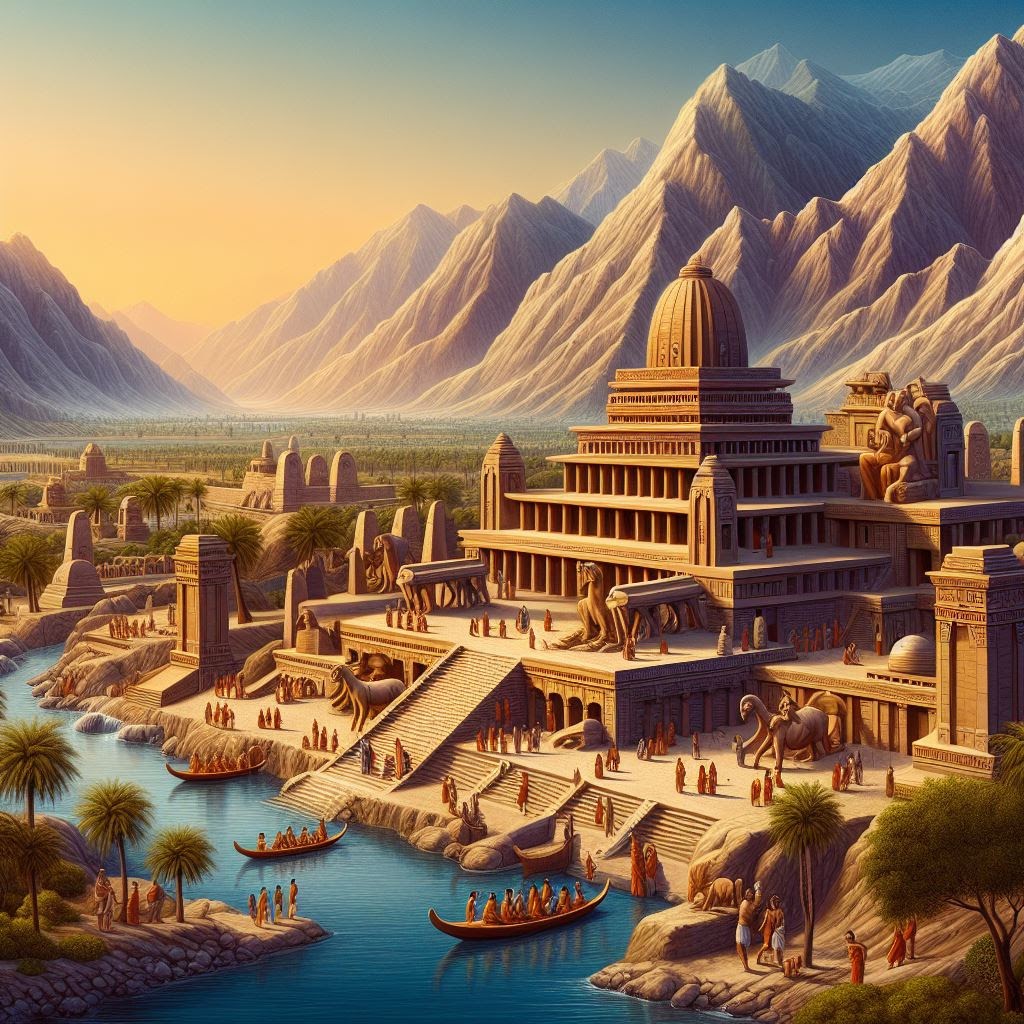
The Indus Civilization is one of the four earliest civilizations in the world, along with the Civilizations of Mesopotamia (Tigris and Euphrates), Egypt (Nile), and China (Hwang Ho).
Civilization forms part of the protohistory of India and belongs to the Bronze Age. The most accepted period is 2500-1700 BC (by Carbon-14 dating).

It can be divided into the following sub-parts.
- Early Phase 2900-2500
- BC.Middle (mature) Phase 2500-2000 BC
- Later Phase 2000-1750 BC
Dayaram Sahni first discovered Harappa in 1921.
RD Banerjee discovered Mohenjodaro, or Mound of Dead in 1922.
Nomenclature of Indus Valley Civilization
- Indus Valley Civilization as it flourished along the Indus River.
- Harappa Civilization, named by John Marshall
- Saraswati-Sindhu Civilization, as most of the sites have been found at the Hakra-Ghaggar River.
- The Indus Valley Civilization was an ancient society that lived mostly in primarily in present-day Pakistan and northwest India, on the rich floodplain of the Indus River and nearby areas.
- There is evidence that people practiced religion in this area around 5500 BCE.
- Farming settlements begins around 4000 BCE, and around 3000 BCE, the first signs of urbanisation appeared.
- By 2600 BCE, many towns and cities had been built. The Indus Valley Civilization was at its best between 2500 and 2000 BCE.
The Indus Valley Civilization's Life
- Specifically, two cities have been excavate:
Mohenjo-Daro on the lower Indus and Harappa which is located upstream. - The evidence suggests that they enjoyed a sophisticate urban lifestyle, with several residences equipped with wells, bathrooms and an intricate subterranean drainage system.
- The social conditions of the residents were similar to those in Sumerian society and better than the social conditions of the Babylonians and Egyptians during that time.
- The social conditions of the locals were comparable to those in Sumerian and Superior to those of the Contemporary Babylonians and Egyptians.
- These cities demonstrate a well planned urbanisation system.
- The evidence indicates that their urban lifestyle was highly developed numerous home featured elaborate underground drainage system, along with bathrooms and wells.
- The Meluhhaites, the men of the black lands, bring to Naram-Sin of Agade all kinds of exotic wares." (The Curse of Agade, Haywood).
- The Indus Civilization utilised a writing system that is still a mystery to this day; all attempts to understand it has been unsuccessful. This particular reason makes the Indus Valley Civilization one of the least well-known of the significant early civilizations of antiquity.
- The use of this writing system has been discovered in a variety of objects, including but not limited to weights, amulets, copper tablets, carved stamp seals, and even pottery.
- The nature of the interaction between these cities is another topic of discussion. It's unclear if they belonged to a bigger kingdom or were separate city-states. There is inconclusive evidence pointing in either direction because the Indus people's writing is still untranslated, and no sculptures of rulers or combat and military campaign scenes have been discovered.
Decline:
- By 1800 BCE, the Indus Valley Civilization began to decline.
- The act of writing began to disappear, and the utilization of regular weights and measures for the purposes of trade and taxation fell out. The connections with the Near East were interrupted, and some cities were gradually abandoned.
- The link to the Near East was cut off, and over time, some towns were slowly abandoned.
- It's not clear why this falls off, but the main reason is the Saraswati River drying up, which started around 1900 BCE.
- Experts say there was a big flood in the area. Potential outcomes would have severely impacted agricultural operations, rendered the economy unsustainable, and disrupted the social structure of the cities.
Agriculture
- It was the backbone of Civilization. The Soil was fertile due to inundation in the river Indus and Flooding.
- Gabarbands and nalas enclosed by dams for storing water were a feature in parts of Balochistan. Grains were stored in granaries.
- Crops Produced wheat, barley, dats, pead, sesamum, mustard, millet, ragi, bajra, and jowar.
- They were the first to produce cotton in the world, which Greeks called Sindon, derived from Sind.
- A fragment of woven cotton cloth was found at Mohenjo-Daro.
Decline of Indus Civilization
|
Views |
Thinkers |
|
External Aggression |
Wheeler, Piggot, |
|
Inundation |
MR Sahani |
|
Epidemic |
KVR Kennedy |
|
Sudden Decline |
Wheeler |
|
Climate Change |
RL Stein and AN Ghosh |
|
Flood |
Marshall, SR Rao |
Major Imports
|
Imports |
From |
|
Gold |
Kolar (Karnataka), Persia (Iran) |
|
Silver |
Persia, South India |
|
Copper |
Khetri(Rajasthan) Arabia |
|
Tin |
Biha, Afghanistan |
|
Jade |
Central Asia |
|
Steatite |
Shaher-i-Sokhta |
|
Turquoise |
Iran |
Important Harappan Sites


.png)
